
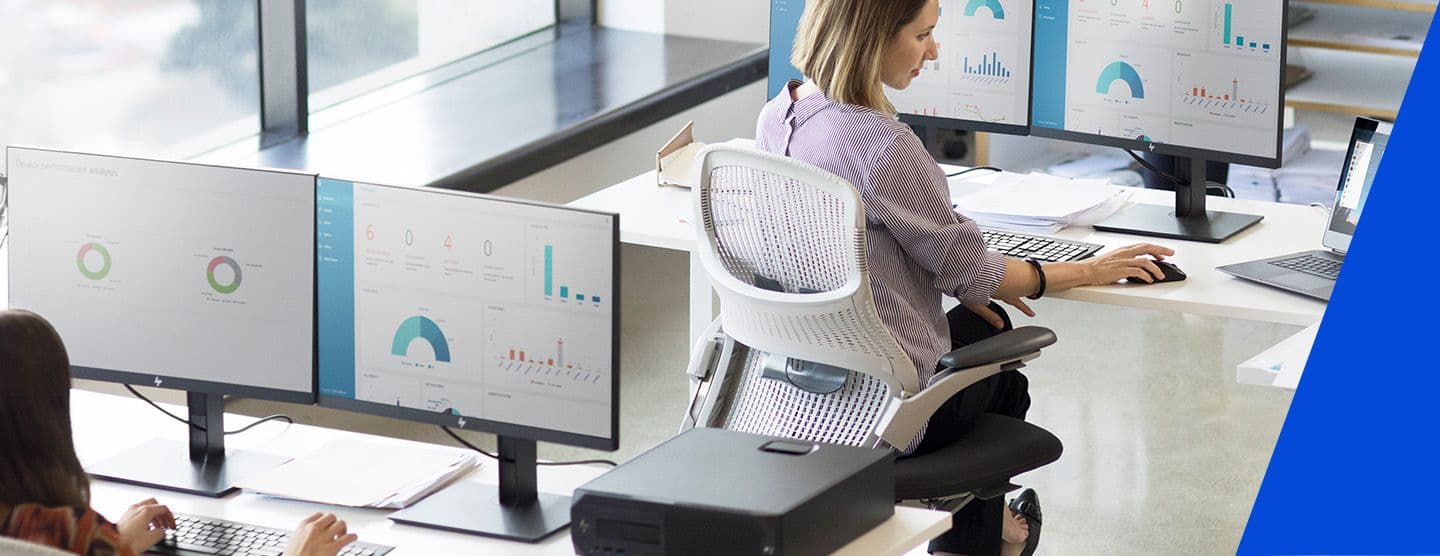
Data is the new oil, but only if devices can keep up. Businesses today generate and analyse massive datasets—from financial models to AI simulations. A standard laptop may handle emails and spreadsheets, but under terabytes of raw data or real-time analytics, it slows down or fails. This delay impacts productivity, insights, and decision-making.
Data-heavy tasks strain devices in multiple ways:
Processing Power: High-performance CPUs (Intel i7/i9 or equivalent) for running complex models.
Memory Capacity: 32GB+ RAM is often essential for smooth operations.
Graphics Acceleration: Dedicated GPUs for AI, visualisations, and simulations.
Storage Speed: High-speed NVMe SSDs for quick data access.
Thermal Reliability: Advanced cooling systems to prevent throttling.
Analysts wait instead of analysing.
Systems overheat and crash.
Devices wear out faster, increasing costs.
Employee frustration grows, reducing retention.
Running predictive models on millions of data points requires workstation-level CPUs and GPUs. An HP ZBook Power drastically reduces processing time.
Medical researchers working with imaging datasets need reliable thermal performance. HP ZBook Firefly ensures stable, cool, and quiet operations.
Handling customer journeys, predictive tools, and dashboards requires seamless multitasking. HP EliteBook provides the memory and speed needed.
High-core CPUs (Intel i7/i9 or AMD equivalent)
Dedicated GPUs for analytics and AI
32GB+ RAM
NVMe SSD storage
Strong thermal design
Enterprise-grade security
Remote manageability
Segment by Role: ZBooks for analysts, EliteBooks for data professionals, ProBooks for support roles.
Streamline Fleets: Fewer models reduce IT overhead.
Plan Lifecycles: Align refresh cycles with workload growth.
|
HP Series |
Best For |
Key Strengths |
|
ProBook |
Basic business data tasks |
Affordable, reliable, entry-level |
|
EliteBook |
Multitasking professionals |
Balanced power, security, mobility |
|
Dragonfly |
Executives on the move |
Lightweight, secure, portable |
|
ZBook Firefly |
Graphics-heavy & analytics workloads |
Workstation-class graphics + portability |
|
ZBook Power |
Heavy AI & data science workloads |
High-end CPUs, GPUs, and RAM capacity |
HP Connect Experience Centres are located in: New Delhi, Gurgaon, Noida, Pune, Guwahati, Surat, Cochin, and Chennai.
Here, IT buyers can:
Test ZBooks with real-time analytics
See EliteBooks managing simultaneous dashboards
Experience Dragonfly laptops in secure mobile setups
Q1. Why do data-intensive workflows need specialised laptops?
Because large datasets and analytics demand higher CPU, GPU, and RAM than consumer laptops provide.
Q2. Which HP laptops are best for heavy data workloads?
HP ZBook Power and ZBook Firefly are designed for AI, modelling, and analytics.
Q3. Is RAM or CPU more important for data analysis?
Both. RAM ensures smooth multitasking; CPUs accelerate processing.
Q4. Do data scientists need dedicated GPUs?
Yes. Many AI and analytics platforms use GPU acceleration.
Q5. How does investing in better laptops save money?
It reduces downtime, prevents overheating, and extends device lifespan—lowering total cost of ownership (TCO).